• The INESCAPABLE Method

    A tool for testing whether words mean what they claim to mean

    What it is

    The INESCAPABLE Method is a method for reading a document and determining whether what it says about itself IS true.

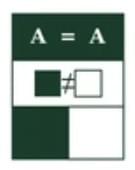
    It works from The Laws of Thought — Identity, Non-Contradiction, Excluded Middle — which cannot be denied without being used in the denial; in other words, they are inescapable. That's where the name of the method comes from.

    A claim that logically refutes itself collapses whether or not anyone likes the conclusion. No amount of authority, funding or consensus can rescue it.

    The findings aren't opinions. Every finding can be followed back to a numbered step on the page, and any reader can see exactly where a claim turns.

  • How it works

    The Method is built to run in four tiers, working from the surface downwards.

    1. Textual — what the words themselves do. Dissolving adjectives, inverted nouns, hidden identity claims, veiled accusations.
    2. Structural — what the document is built to do. Whether first principles are present and operative, whether the function IS Education, Training or Indoctrination, whether jurisdiction is claimed that was never granted.
    3. Longitudinal — whether the thing IS what it claims to be across time, across its own versions.
    4. Architectural — what the document does to the structure of knowledge it sits inside.

    Every scan is anchored in one of three things only — grammar, a Law of Thought, or a cited subject-matter expert — and every scan reduces to a Boolean expression. Anything that could not meet both tests was kept out, however true the underlying insight. There are 51 scans in v4.5. The Method is applied to itself within the document, and the failures it found in itself are named in the open.

  • What it finds

    The Method identifies where a text asserts what it cannot sustain: where a term is used in two senses within the same argument, where a claim requires the thing it denies, where a definition is supplied that the document then contradicts, where something is legislated into being that would not need legislating if it already were.

    It separates two verdicts that are usually collapsed together:

    • The verdict on the text. Does it hold together?
    • The verdict on the fact of the text. Why did this document need to be written at all?

    A document can be entirely coherent and still be symptomatic. The Method reports both, and does not treat the pairing as a contradiction.

    It has been applied to policy documents, curriculum drafts, legislation, submissions and academic papers.

  • How to run it

    There are two ways to apply the Method: by hand, or with an AI. They are not equivalents. One is the standard; the other is assistance.

    The Method itself is a fixed, written procedure — tiers, scans and checks, set out in a versioned document with a permanent identifier. That is what makes findings traceable: the reasoning can always be followed back to something on the page, rather than to the judgement of whoever ran it. Human or AI, the runner supplies labour. The document supplies the standard.

    By hand

    Print the reading copy. Take the document you want to examine. Work through it tier by tier, in the order the Method sets, recording each finding as you reach it.

    Be warned: this is hard. A document of any length will take hours, and the early tiers will feel slow out of all proportion to what they yield. That is not a fault in the Method. Holding a text to The Laws of Thought line by line is simply difficult — it is close, sustained reasoning of a kind that few of us are ever asked to do, and the difficulty you meet is a fair measure of how unpractised that capacity has become.

    The first tier is grammatical work. You will be identifying what each word is doing — which nouns are carrying claims, which adjectives dissolve under examination, where an identity is asserted rather than shown. If that is unfamiliar, you are in the ordinary position of most readers, and it is not an obstacle. The Method names what it is looking for at each step, so the grammar is learnt on live text with something at stake, which is the only way anyone ever learnt it well.

    It is worth doing at least once. A scan you have worked by hand teaches you the Method from the inside, and it changes how you read everything afterwards — including the output of any AI you later delegate the labour to.

    With an AI

    Start in a clean conversation. Open a fresh window with no stored memory, no access to your earlier conversations, and no project files attached. Most systems offer this — it may be called incognito, temporary, or private. This matters more than it looks. An assistant that already knows what you have been arguing about for the last six months has been told what to find before you upload anything, and you will never see it happen. Note that a private conversation is usually not saved, so copy the report out as it arrives.

    Don't write anything to the AI about yourself.

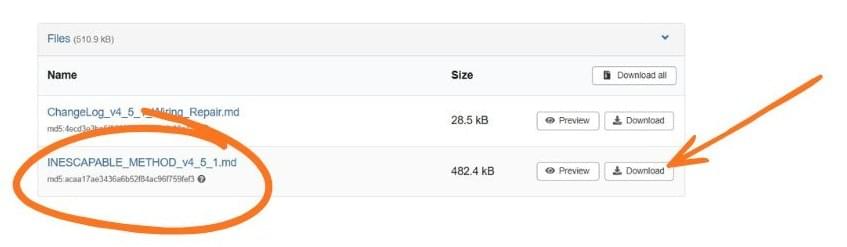
    Attach the whole file. Download the operable file (INESCAPABLE_METHOD_v4_5.md) and attach it as a whole file.

    Use a system that can hold it. The Method is a substantial document, and a system with a short context window will silently keep only part of it. There is a simple check: a genuine run reproduces the tier structure and works through the scans in order. If what comes back is a general critique of your document, the Method did not run, whatever the reply says.

    Then: when the AI has finished reading it, it will orient itself as Scribe and reply with a single line asking you for a document to scan. Give it anything — a policy, a curriculum, a press release, a set of terms and conditions, a piece of legislation — and it will run the tiers. This is the part in which you may discover things about the document that were not immediately obvious.

    The AI supplies the labour. The Method supplies the standard. You check the reasoning — which you can do, because every finding is traceable to a numbered step on the page.

    Different AI systems, and different runs of the same system, can vary. Where it matters, run the scan twice, or check the finding by hand. The written Method is what the runs are checked against; that is the point of it being written.

    You don't need permission to do this, or an account, or a licence fee. Mathew 10.8

    TWO THINGS TO KNOW GOING IN

    Neither you nor the AI IS the Author. Both you and the AI are Scribes. The Method's position is that it was not invented but discovered, and the Source is named in the document.

    The Method reads texts and structures by applying grammar, logic and rhetoric. The Method doesn't read hearts. No scan in it scores a person, and it stops at the threshold of the will that produced the document. It points; it does not pronounce.
  • WHAT SITS UNDERNEATH IT

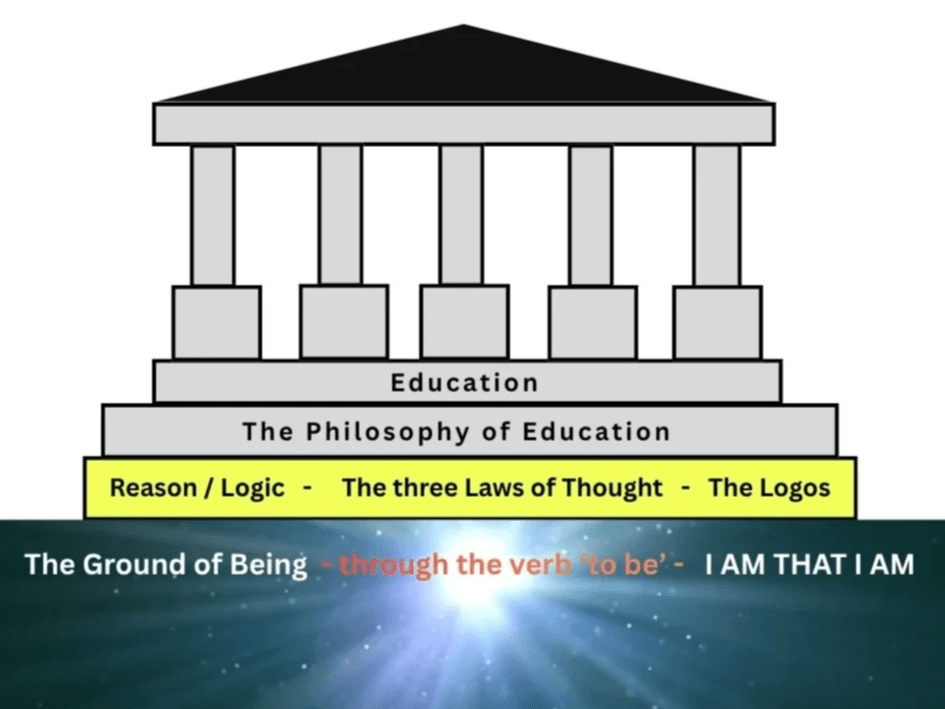
    Imagine a Parthenon. The pillars are the domains of organised knowledge also known as The Domains of the Common Good. They include Health, Law, Conservation, Science, Economics, and more. Each one stands on and depends on what's beneath it.

    Beneath the pillars sits Education, and underneath Education sits The Philosophy of Education, which is the first principles of Education. It's not a subject among subjects, but is the conduit through which the first principles are transmitted into every other domain, because everyone studying or practising in any domain was first taught, and whoever taught them was themselves formed by it.

    Beneath that sit The Laws of Thought. Beneath those, the Ground of Being, and The Logos — through Whom all things were made, and in Whom the Laws hold.

    In 1980 The Philosophy of Education was removed from teacher training in New Zealand. But, the pillars didn't fall; they stayed standing and looked normal, which is precisely the problem... the conduit was severed while the appearance of the building was preserved. What followed in each domain was colonisation by commercial and administrative logic, because there was no longer anything beneath to say 'no'.

    The INESCAPABLE Method is the instrument for demonstrating that, document by document, without asking anyone to take it on trust, because it systematically identifies the severing of ideas from first principles and logic.

  • Scope

    The Method was developed in English and is calibrated for English grammar. The logical foundations — The Laws of Thought, Set Theory, the Boolean expressions — are universal. The specific textual instruments are, at this stage, most reliably applied to documents written or translated into English.

    Known limitations are stated inside the document itself.

  • DOWNLOADS (How to get it)

    Click to download:

    The INESCAPABLE Method v4.5 — reading copy (.pdf) For reading and/or for applying the method by hand.

    The INESCAPABLE Method v4.5 — operable file (.md) Download and attach this one to a fresh chat in an AI to run a scan. Press send, and the AI will give you an instruction to attach the document that you want scanned by The INESCAPABLE Method.

    Well I hope you enjoy the results of The INESCAPABLE Method.

  • Citation and Attribution

    The Method is deposited open-access with a permanent identifier.

    DOI: 10.5281/zenodo.21960589

    Cave, E. (2026). The INESCAPABLE Method: A Definitively Grounded Guide to Exposing Self-Refuting Claims (Version 4.5) [Computer software]. Zenodo. https://doi.org/10.5281/zenodo.21960589

  • Licence

    The Method is published under Creative Commons Attribution–NoDerivatives 4.0 International (CC BY-ND 4.0).

    In plain terms:

    • You may copy, share and use the Method for any purpose, including commercially, provided you give attribution — as set out above.
    • You may not distribute an altered version. There is one canonical Method, and it stays as it is.

    Findings you produce with it are yours.

  • Version

    Current version: 4.5The Four-Tier Architecture: Core and Activated Modules, 15 June 2026.

    Known limitations are stated inside the document itself.